Common symptoms
Constipation when you go every day: causes and what helps
Dr Muhammad Saquib Munir · Bachelor of Medicine and Bachelor of Surgery · GP trainee
Why can I be constipated if I go every day?
Constipation can mean passing stool that is hard, painful or difficult to get out, or repeatedly feeling that some is left behind. A small bowel movement each morning may not bring comfortable emptying.
The large bowel absorbs water from stool. If stool travels slowly, it can lose more water and become hard. Emptying also needs the muscles around the back passage to relax at the right time. If they do not coordinate properly, even soft stool may be difficult to pass. This is one kind of defecatory disorder, meaning a problem getting stool out of the rectum, the last part of the bowel.
Use the Bristol Stool Chart to describe the problem
This original drawing uses the seven Bristol stool types. Types 1 and 2 are hard patterns often seen with constipation. Types 3 and 4 are formed; types 5 to 7 are progressively looser. A person with type 3 or 4 stool can still have difficulty emptying.
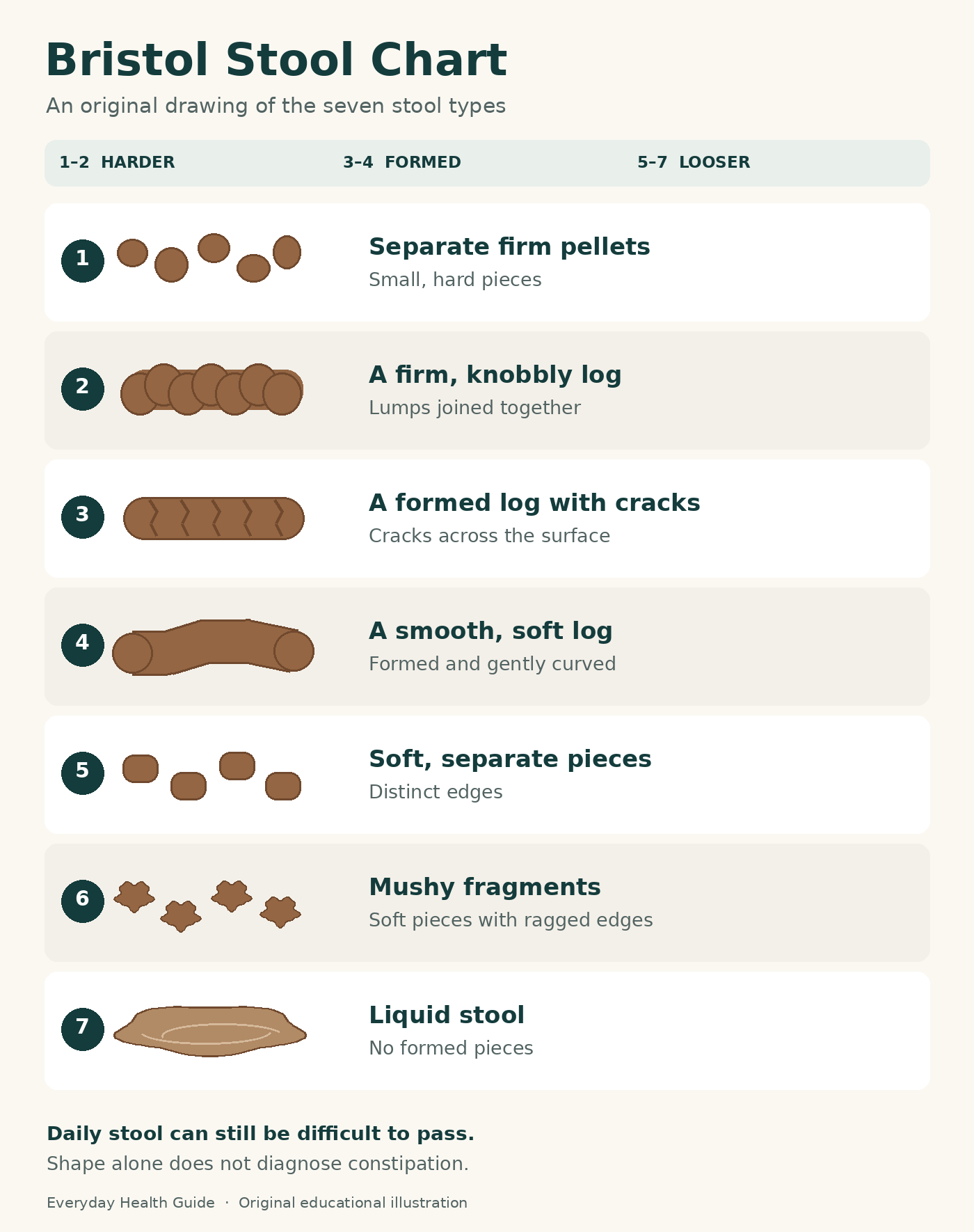
Use the number alongside a description of straining, pain or leakage. The chart describes shape and consistency, not stool colour, the cause of symptoms or the right medicine on its own.
What can cause it?
Several contributors can occur together:
- Daily habits: too little fibre or fluid, limited movement, changes in routine, or repeatedly putting off the urge to go.
- Medicines and supplements: opioids such as codeine; iron or calcium supplements; antacids containing calcium or aluminium; some antidepressants; calcium channel blockers such as verapamil; and anticholinergic medicines, including some bladder medicines and medicines for cramps. These can slow bowel activity or make emptying harder.
- Bowel conditions: irritable bowel syndrome with constipation usually includes recurring abdominal pain as well as bowel changes. Constipation alone does not establish IBS.
- Other health problems: an underactive thyroid, diabetes, coeliac disease, neurological conditions or a narrowing in the bowel may be relevant when the history or examination suggests them.
Do not stop a prescribed medicine yourself. A clinician can review the reason for it, possible alternatives and whether constipation treatment is needed. If you take iron, our guide to tiredness and iron tablets explains why its need and tolerability should be considered together.
When should I get medical help?
Go to an emergency department for severe or worsening abdominal pain with vomiting, a very swollen abdomen or inability to pass wind; heavy or nonstop rectal bleeding; or back pain with new numbness around the groin, genitals or bottom, difficulty starting or passing urine, or loss of bladder or bowel control. The back symptoms can signal pressure on spinal nerves, called cauda equina syndrome. Call your local emergency number if you cannot travel safely, and do not drive yourself. Seek urgent medical advice today for constipation with constant abdominal pain, persistent vomiting, fever, blood in the stool or black, tar-like stool when the earlier warning signs are absent. Arrange a prompt appointment for a new persistent change, especially if constipation starts after age 50; unexplained anaemia or iron deficiency; weight loss; a lump in or around the back passage; recurrent symptoms; or treatment that is not helping. Mention a family history of bowel cancer. These signs do not prove cancer, and younger adults with concerning changes also need assessment. Passing some stool does not rule out a partial blockage.
Investigations: what might a clinician check?
Explain what is difficult: hard pellets, prolonged straining, pain, leakage or trouble passing soft stool. Bring a list of medicines and supplements. The clinician may examine your abdomen and, with your agreement, your back passage to check for retained stool, a lump or a muscle problem.
| Test | Why it may be useful |
|---|---|
| Selected blood tests | A blood count and iron tests can check for anaemia or iron deficiency. Thyroid, calcium or coeliac tests may be useful if there is a reason to suspect these problems. Not everyone needs every test. |
| FIT stool test | Looks for tiny amounts of blood to help guide investigation of a concerning change in bowel habit or iron-deficiency anaemia. It is not a stand-alone test for the cause of constipation. |
| Colonoscopy or another bowel examination | Checks the bowel lining when symptoms, examination, test results or screening needs justify it. Constipation alone does not automatically require a colonoscopy. A rectal lump may need referral without waiting for FIT. |
| Anorectal manometry and balloon expulsion test | Manometry measures pressure and muscle coordination in the rectum and back passage using a small tube. The balloon test checks how easily a small balloon can be pushed out. |
| Bowel transit test | Tracks how quickly material moves through the large bowel when persistent symptoms need further assessment. |
Some people need defecography, imaging that shows what happens while the rectum empties. These specialist tests answer different questions from a colonoscopy. A straightforward case may begin with a treatment trial.
Treatment: practical steps
1. Adjust food and fluid without overdoing fibre
If your diet is low in fibre, add foods such as oats, fruit, vegetables, wholegrain bread, beans or lentils gradually. Drink regularly; if you have a prescribed fluid restriction, ask how to adapt this advice.
Extra fibre, particularly large amounts of bran, can worsen bloating and discomfort in some people with slow-transit constipation, where stool moves unusually slowly through the bowel. Opioid-related constipation also needs a different plan: do not keep adding fibre supplements or start a bulk-forming laxative without advice. Normal fibre-containing food does not need to be eliminated automatically. If bloating increases, review the amount and type rather than repeatedly adding more. Our bloating after meals guide discusses other possible contributors.
2. Make emptying easier
- Respond to the urge rather than regularly delaying it.
- Allow an unhurried opportunity after a meal, when bowel activity often increases.
- Sit fully on the toilet. If safe and comfortable, support your feet on a stable low stool, raise your knees above your hips and lean slightly forward.
- Relax and breathe rather than holding your breath and repeatedly pushing. Take a break if nothing happens.
Include suitable movement, such as a manageable walk, adapted to your health and mobility.
3. Choose a laxative to fit the stool pattern
For an adult without warning signs, suspected blockage or faecal impaction (a build-up of stool that is difficult to clear), a pharmacist can help apply this usual UK approach:
Hard stool: a bulk-forming laxative is often tried first if suitable and you can drink enough. If stool remains hard or this is unsuitable, an osmotic laxative may be added or used instead.
Soft stool that remains difficult to pass, or a feeling of incomplete emptying: a short course of a stimulant may be considered. Persistent difficulty also needs review for an emptying disorder; repeatedly softening stool further may only cause loose stool.
Inadequate response: review the diagnosis, medicine choice and how it has been used. A clinician may consider a suppository or another treatment rather than an unplanned combination of products.
| Type and examples | What it does | Where it fits and main caution |
|---|---|---|
| Bulk-forming: ispaghula, also called psyllium | Holds water and adds bulk to stool. | Often an initial option for hard stool. Needs suitable fluid intake and may increase bloating. Avoid in opioid-induced constipation or suspected impaction or obstruction. |
| Osmotic: macrogol, also called polyethylene glycol; lactulose | Keeps or draws water into the bowel to soften stool. | Add or switch when stool stays hard, or use when bulk-forming treatment is unsuitable. May cause wind, cramps or diarrhoea. |
| Stimulant: senna or bisacodyl | Encourages bowel muscle activity. | May help when stool is soft but difficult to pass. Can cause cramps; use for the agreed duration. |
| Rectal treatment: a suppository, which dissolves in the back passage | Acts near the stool waiting in the rectum. | Bisacodyl can stimulate emptying. Glycerol, also called glycerin, can soften stool and stimulate the rectum. Selection depends on examination and the treatment plan. |
Suppositories are not interchangeable. In assessed faecal impaction, NHS guidance distinguishes bisacodyl for soft retained stool from glycerol alone, or glycerol with bisacodyl, for hard retained stool. Glycerol is therefore not simply the default treatment for every soft-but-difficult stool. Some people need a prescribed mini-enema. Do not start a high-dose impaction regimen, repeated enemas or manual removal yourself.
If opioids are the cause: an osmotic laxative with a stimulant is often needed instead of a bulk-forming laxative. A clinician can consider other prescription treatments if this is insufficient.
Ask about suitability before using a laxative if you are pregnant, frail, have swallowing difficulty, kidney or heart disease, or a significant bowel condition. Products can differ in salts and interactions. Follow the packet or prescription. NHS advice is to seek advice if a self-bought laxative has not helped after three days, and not to take it for more than seven days without advice. Longer prescribed treatment may be appropriate for chronic constipation.
4. Get assessed if emptying remains difficult
If soft stool still takes prolonged straining, report that clearly. When assessment identifies poor muscle coordination, pelvic floor biofeedback can teach the muscles to relax and work together, using feedback from sensors. This is different from simply being told to strengthen the pelvic floor.
Illustrative example: a treatment changes hard pellets into soft stool, but each visit still involves prolonged pushing. That is a reason to reassess emptying, rather than automatically increasing the laxative.
What if I have loose leakage as well?
Liquid stool can leak around retained stool in faecal impaction, often in the rectum. Small frequent stools or apparent diarrhoea can occur without effective emptying.
Leakage after prolonged constipation needs assessment and sometimes a prescribed clearance plan. Do not assume it is ordinary diarrhoea or try to remove the stool yourself.
Follow-up: how do I judge progress?
Aim for soft, formed stool that passes with less effort and a more comfortable sense of emptying. More toilet visits or repeated watery stool are not the goal.
For a few days, record the Bristol type, straining or pain, unfinished feeling or leakage, and what treatment you used. This helps show whether stool hardness or emptying is improving.
Illustrative progress note: “I still go once a day, but the stool is softer and passing it takes less effort.” That is useful improvement even though the frequency is unchanged.
Agree a review point when starting treatment. Laxatives usually act sooner than food changes. If symptoms persist, review the explanation, adherence and side effects before escalating. Ongoing treatment may be needed when a contributing medicine or condition continues; follow a supervised plan for reducing it once symptoms settle.
Questions for your clinician
- Is my main problem hard stool, slow movement or difficulty emptying?
- Could a medicine or supplement be contributing?
- Which laxative should I try first, and what should happen if it does not help?
- Do I need blood tests, FIT or an examination of the bowel?
- If soft stool remains hard to pass, would muscle-function testing or biofeedback help?
This guide is for adults. Children need age-specific advice. Pregnancy, frailty and significant illness can change treatment choices. The medicine sequence reflects UK guidance; availability, referral pathways, screening programmes and emergency numbers differ internationally.
Related reading
For blood noticed after passing stool, see Bright red blood after a bowel movement: is it piles, and when should I get checked?
If reduced fluid intake may be contributing, see our dehydration guide.
For a separate episode of loose stools, see What should I drink and eat when I have diarrhoea? The leakage described above needs assessment rather than automatically following diarrhoea advice.
Sources and further reading
Public sources checked on 4 November 2026. The chart artwork, examples and preparation questions are original educational aids. The chart uses established Bristol stool-type categories; it is not a diagnostic test. Direct CKS access was unavailable during preparation; the treatment sequence was cross-checked against the accessible NHS and Scottish Government guidance listed above.
NIDDK: Symptoms and causes of constipation
Mayo Clinic: Constipation — symptoms and causes
University Hospitals Plymouth NHS Trust: Bristol Stool Chart and bowel function
The Dudley Group NHS Foundation Trust: Bowel obstruction
NHS: Sciatica — urgent spinal-nerve warning signs
NICE NG12: Suspected cancer — colorectal cancer recommendations
Queensland Health: Constipation — assessment and concerning features
NIDDK: Diagnosis of constipation
NIDDK: Treatment for constipation
NIDDK: Eating, diet and nutrition for constipation
South Tees Hospitals NHS Foundation Trust: Getting your position right
Scottish Government: Polypharmacy Guidance 2026–2029 — management of constipation
BSW NHS: Management of constipation in adults
Northern Care Alliance NHS: Constipation — fibre and slow gut transit
American Gastroenterological Association: Hard-to-treat constipation — patient guide
NHS: Symptoms of irritable bowel syndrome
NICE CKS: Constipation — clinical reference for reviewer verification
Sources accessed 2026-11-04. Local care pathways vary. These guides use international wording; emergency numbers and services depend on your location.
This guide is general education, not a diagnosis or treatment plan. Content is AI-assisted. Clinical review applies to the article version and date shown above. Read our editorial policy. Report an error or suggest a correction.